Southampton based13 live client websitesNo commission on your salesStripe & PayPal paymentsSSL and GDPR readyNo long contract
the New Forest and Waterside
EPOS and direct ordering for New Forest kitchens.
Food businesses in the forest are small, seasonal and almost entirely dependent on people who do not live here. A Lyndhurst tearoom, a Brockenhurst pub kitchen, a Lymington deli — all of them do most of their year between Easter and October, serving visitors who found them that morning on a phone.
That visitor is deciding between you and three other places within a mile, and they are deciding on what they can see. A proper menu online, with prices and photos, does more work here than it does in a city where people already know the options.
This is a till and ordering system built for that: the screen, the printer, the drawer, and an ordering page that works when somebody is standing in a car park with one bar of signal.
From£1,495+ £49/monthComplete hardware bundle and setup. Software and support £49/month. No commission.
What trading in the New Forest actually looks like.
What the area runs on
The New Forest is a national park with a visitor economy and no large town inside it. Trade is spread across villages — Lyndhurst, Brockenhurst, Lymington, Ringwood, New Milton, Fordingbridge — each with its own small high street. Tourism, hospitality and holiday letting carry the area, with a wealthy resident and second-home population underneath.
The independent trade here
Almost every business here is small, independent and seasonal to some degree. Holiday cottages, tearooms, pubs with kitchens, campsites, equestrian services and the trades that serve them. Customers are frequently visitors who have never heard of you and are choosing on a phone, which makes being findable worth more here than local reputation alone.
How the year moves
Very seasonal, and the shoulder months matter more than people expect. School holidays, bank holidays and the autumn colour weeks fill accommodation. Winter is genuinely quiet outside Christmas, which is when direct bookings from last year's guests earn their keep.
Getting around
Brockenhurst station is the main rail link, direct to London Waterloo and Southampton. Lymington runs the ferry to Yarmouth on the Isle of Wight. Villages are far apart with limited bus service and patchy mobile signal in places, so visitors without a car depend heavily on pre-booked transport.
Covered here
Lyndhurst
Brockenhurst
Lymington
Ringwood
New Milton
Totton
Hythe
SO40
SO41
SO42
SO43
BH24
BH25
Why it is different here
Three things about the New Forest that change the job.
01
Your customer found you forty minutes ago
Very little trade here comes from habit. A family parks in Lyndhurst, searches for lunch, and picks from what the phone shows them. That means your menu being visible and legible online is not marketing — it is the actual point of sale. A PDF menu from 2019 loses you that family to the place next door.
02
Seasonal trade punishes fixed costs and rewards fixed systems
A tearoom doing most of its money in five months cannot carry a heavy monthly bill through the winter. A one-off build and a flat fee with no commission suits that shape far better than a percentage that scales up exactly when you are busiest and gives nothing back when you are not.
03
Signal is genuinely patchy and the till has to cope
Parts of the forest have unreliable mobile and broadband. A till that stops working when the connection drops is useless here. This one keeps taking orders and card payments offline and catches up when it reconnects, which in a village kitchen is not a nice-to-have.
Built for this patch
What we set up for a New Forest kitchen
Configured for a seasonal village business:
Your full menu online with photos — the main thing a visitor decides on
Collection and pre-order for walkers and day visitors
Seasonal hours and a simple way to close for the winter months
Offline mode tested properly, because the connection here will drop
Delivery zones across SO40 to SO43, BH24 and BH25 if you deliver at all
Installed and your team trained in person before the Easter trade starts
The numbers
Work out what the apps take off you in a year.
A takeaway putting £6,000 a month through a delivery app. Same food, same kitchen, same customers. The only difference is who takes the order.
Line
Through the apps
Your own system
Orders through the channel
£6,000
£6,000
Commission (14% + VAT)
− £1,008
£0
Card processing (1.5% + 20p)
included
− £90
What the system costs you
£0
− £49
You actually keep
£4,992
£5,861
£869 a month. £10,428 a year. The complete system with the till, the printer and the drawer pays for itself in about seven weeks — and that is before you count the customers you can now email.
A closer look
The three bits that do the work.
The till
One screen for walk-in, phone and online.
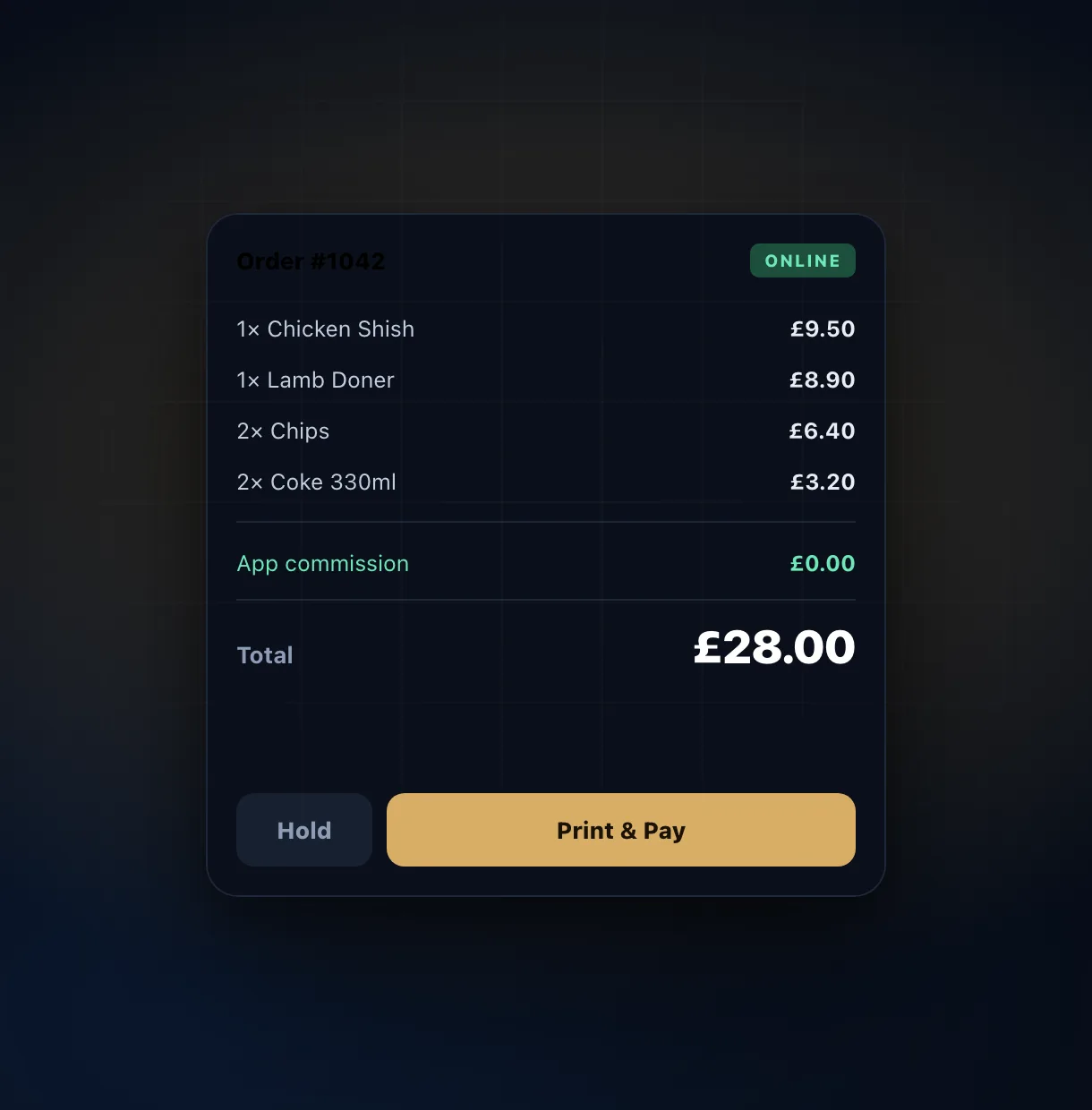
Every order lands in the same place, whether someone walked through the door, rang up or ordered on your website. No more guessing which screen the order is on.
Your menu laid out with pictures, not codes
Options and extras built in — sauces, sizes, no onions
Split bills, holds and refunds without a manager code
Keeps working if the broadband drops
The kitchen
The order prints itself. Nobody reads anything out.
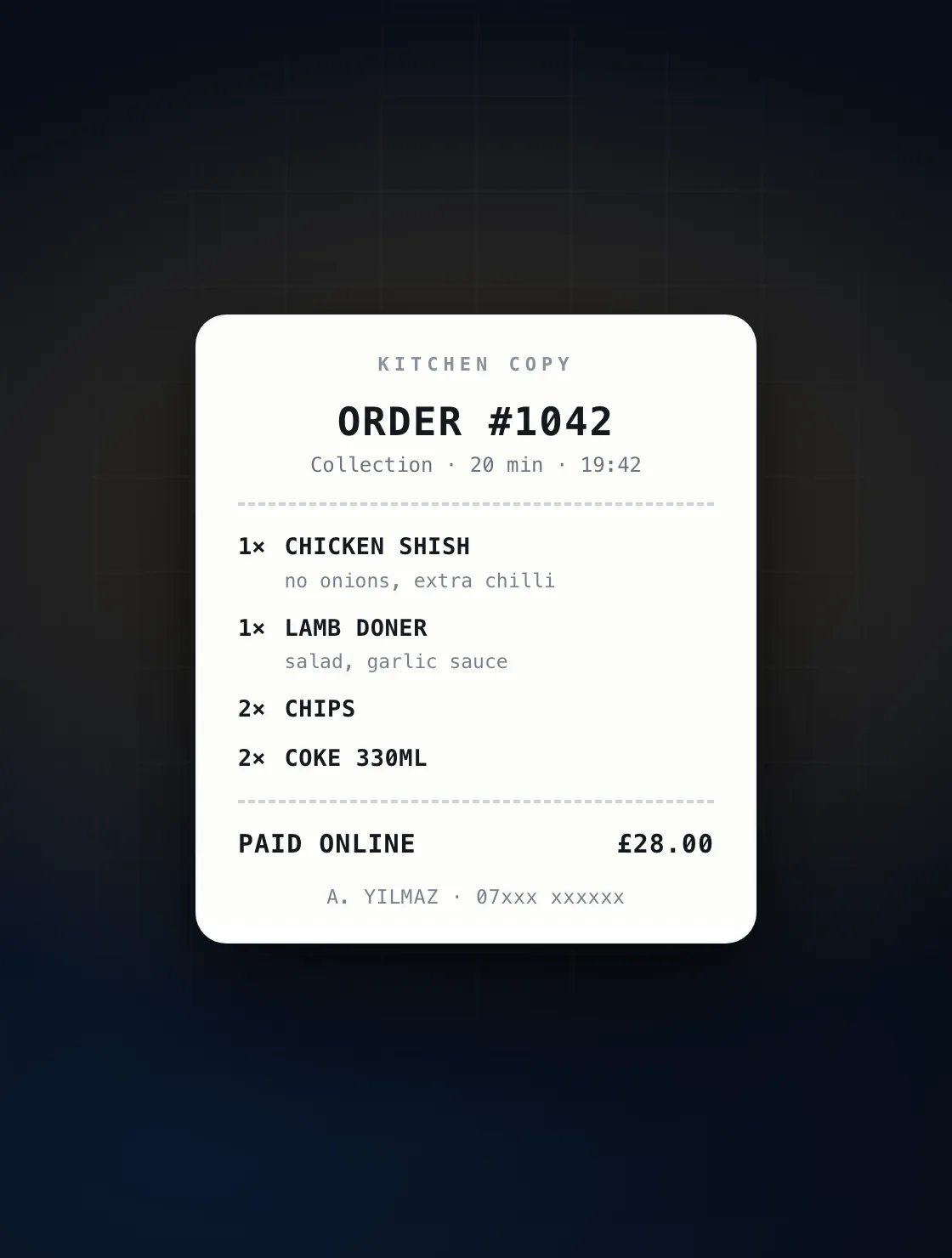
This is where the mistakes stop. The ticket goes straight to the kitchen printer exactly as the customer typed it, so nothing is misheard and nothing is scribbled down wrong.
Thermal printer with auto-cut, wired to the till
Prints the moment the order is paid for
Special instructions printed in full
A second printer for the bar or the pass if you need one
Your ordering website
Your name on the order. Not theirs.
Customers order from a website with your branding, your photos and your prices. And when they do, you get their phone number — which the apps will never give you.
Collection and delivery, with your own delivery zones
Card payment or cash on collection
Customer phone numbers and order history, kept by you
Text your regulars an offer on a quiet Tuesday
How it works
Four steps. Nothing for you to learn.
1
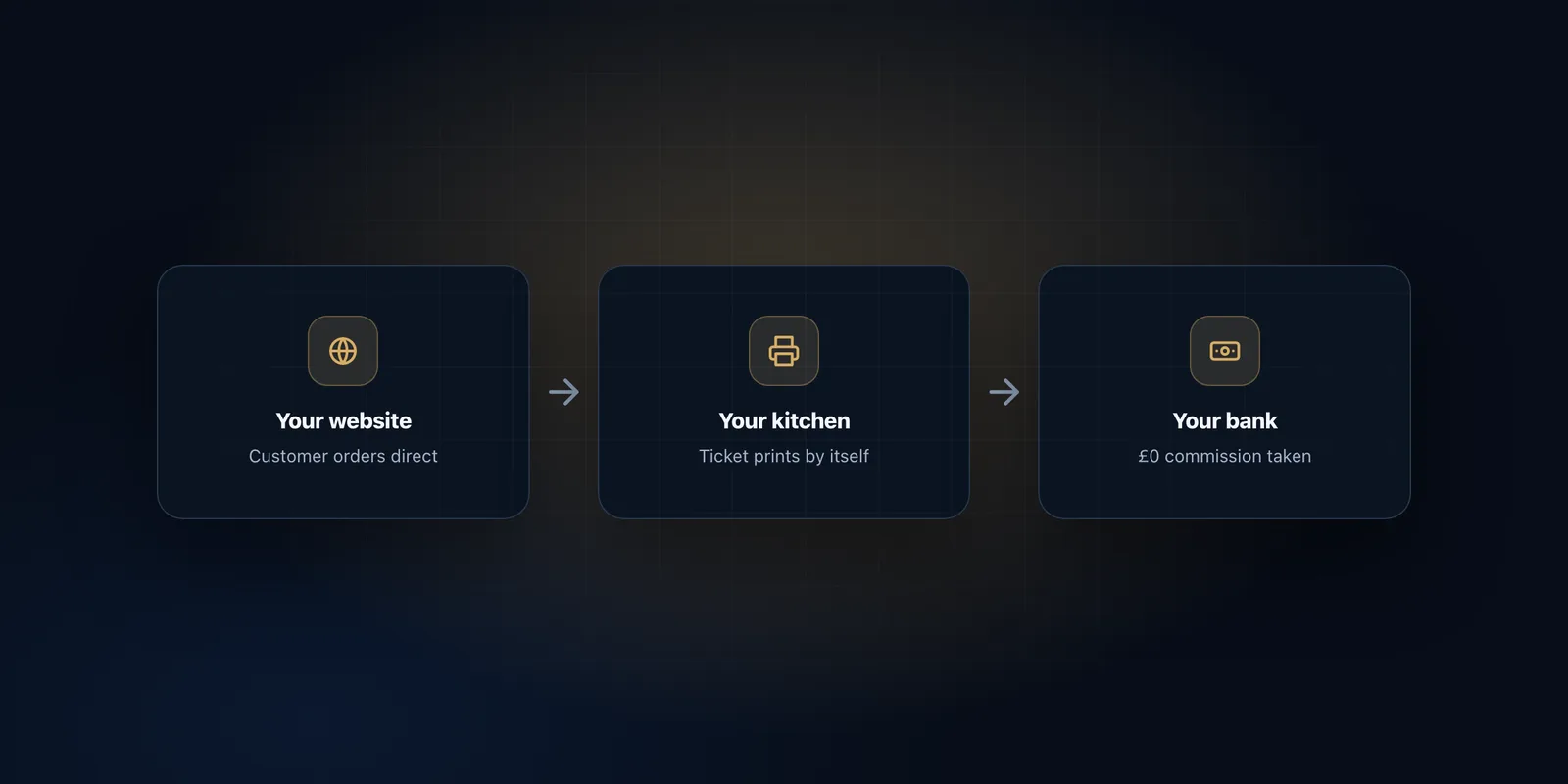
Customer orders on your website
Your menu, your photos, your prices. Collection or delivery.
2
The order prints in the kitchen
Straight to the kitchen printer. Nobody has to read anything out.
3
It lands on the till too
Walk-in, phone and online orders all sit on one screen.
4
Money goes to your bank
Card payments settle to your account. Nothing held back.
Side by side
Your own system vs. the delivery apps
Feature
Pathrone
Delivery apps
Commission per order
£0
You own the customer list
Your branding on the order
Till, printer and drawer included
Works offline
Cost you can predict
Fixed monthly
Included
What arrives in the box
Touchscreen till
15-inch screen, ready to use the day it arrives.
Kitchen printer
Thermal printer with auto-cut, wired straight to the till.
Cash drawer
Heavy steel drawer that opens with the sale.
Your ordering website
Menu, photos, collection and delivery, card payments.
Menu loaded for you
Send us your current menu. We put the whole thing in for you.
Setup and training
We set it up and show your staff how to use it. In person, locally.
Nearby work
Built for businesses down the road.
Two of these are food businesses inside the forest itself, built for exactly this kind of visitor-led trade.
Hardware is yours from day one. The monthly fee covers software, updates and support — cancel any time.
The hardware is yours. The customers are yours.
You are buying a system, not renting your own shop back off somebody. Everything that matters stays in your name.
Hardware is yours outright from the day it arrives
Twelve month warranty, with local callouts rather than postage
Your customer list exports to a spreadsheet whenever you ask
No contract on the monthly fee — cancel any time
Asked locally
Questions we get from the New Forest.
We are a tearoom, not a takeaway. Do we need online ordering?
You need your menu online far more than you need delivery. Most forest places use the ordering side for collection and pre-orders and the till for everything else. Getting the menu properly visible to someone searching for lunch in Lyndhurst is the part that pays.
We close for part of the winter. Does the monthly fee carry on?
You can pause the monthly plan over a closed season and restart it. Tell us when you shut and when you reopen and we handle it. Nothing is lost while it is paused.
Our broadband is unreliable. Is that a problem?
Not for the till — it works offline and syncs later, which is specifically why we flag offline mode for forest businesses. Online orders do pause while you have no connection, but the shop side carries on taking money.
Can holiday cottages point guests at our menu?
Yes, and it is one of the best sources of trade here. Cottage owners are looking for things to put in the welcome book. A link to a proper menu with prices is far more useful to them than a phone number.
Questions
The things everybody asks.
How much commission do you take on orders?
None. Not on the first order and not on the ten thousandth. You pay the one-off cost and the monthly fee, and that is it. Your card processor charges its own standard fee for taking payment, usually around 1.5% plus 20p, and that goes to them.
Can I still use Just Eat or Deliveroo as well?
Yes, and most places do at first. Keep them running while your own ordering site builds up, then push your regulars to order direct because it is cheaper for you. You do not have to choose on day one.
What if the internet goes down?
The till keeps working. You can carry on taking orders and payments in the shop, and everything syncs when the connection comes back. Online orders will pause until you are back online, same as any system.
Do I have to put my menu in myself?
No. Send us your current menu in any form — a PDF, a photo, a takeaway leaflet — and we type the whole thing in for you, including prices and options.
What happens if the hardware breaks?
The hardware comes with a 12-month warranty. If something fails in that time we replace it. We are local, so for most problems we come to you rather than posting things back and forward.
Is it hard for staff to learn?
It is a touchscreen with pictures of your menu on it. We come in and train your team on the day it is installed, and most people are confident within an hour.
Can I set my own delivery zones and charges?
Yes. You draw the area you deliver to by postcode and set a charge and a minimum order for each zone. Anyone outside it is offered collection instead of being told no.
Can I pause online orders when it gets too busy?
One tap on the till. You can pause ordering, push the collection time out to 45 minutes, or mark individual items as sold out. It updates on the website immediately.
Does it handle options like sizes and extras?
Yes, and this is where most of the money is. Sizes, bases, sauces, extra toppings, meal deals — all set up as you want them, and all printed in full on the kitchen ticket.
Can I see what sold last week?
Yes. Daily and weekly totals, your best and worst selling items, and the split between collection and delivery. Enough to tell you what to push and what to take off the menu, without turning into accounting software.
What if I want to move to a different system later?
Your menu, your customer list and your order history all export to a spreadsheet, and the hardware is yours. There is nothing holding you here except whether it is working for you.
In the forest the customer is a stranger with a phone and a forty-minute attention span. Being the place with a readable menu and a working till is most of the battle.